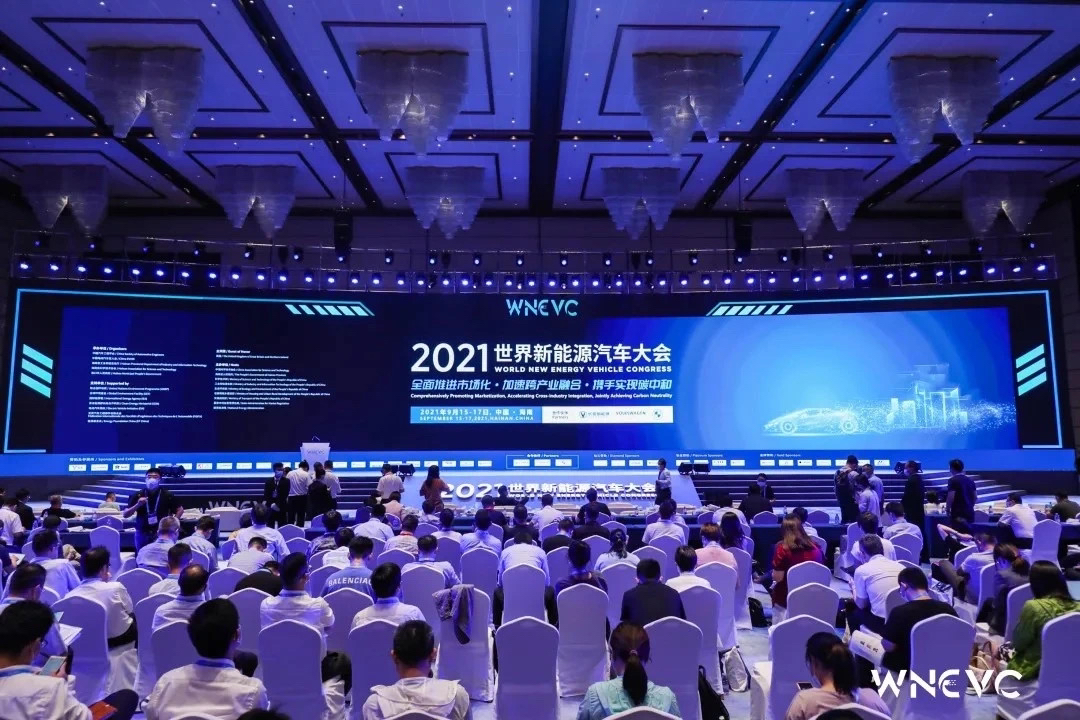
On September 15-17, the 2021 World New Energy Vehicle Congress (WNEVC 2021) was held in Hainan, China. The
congress further deepened the exchanges and cooperation in the NEV industry, aiming to accelerate the
transformation of the global automobile industry. The "Global NEVs Cutting-Edge and Innovative Technologies"
selection is another important event held around the same time as WNEVC 2021, and it is also the first of
its kind for the global NEV technology.
1. What is Huawei AI BMS?
Huawei AI BMS connects the vehicle-mounted BMS of EVs to the cloud, evaluates data through cloud AI
algorithms, provides better battery management strategies and battery failure warnings, and guarantees the
NEV safety.
2. Why introduce AI into BMS?
AI is redefining various industries. In terms of EV batteries, traditional BMS cannot effectively predict
failures such as battery thermal runaway in the low-dimensional data space. Huawei uses "device + cloud +
AI" collaboration and innovatively uses AI algorithms to train and explore large amounts of data. By finding
implicit relevance and trends, thermal runaway warnings can be issued one day in advance, with a fault
detection rate of more than 90% and an error rate of less than 0.1%/month.
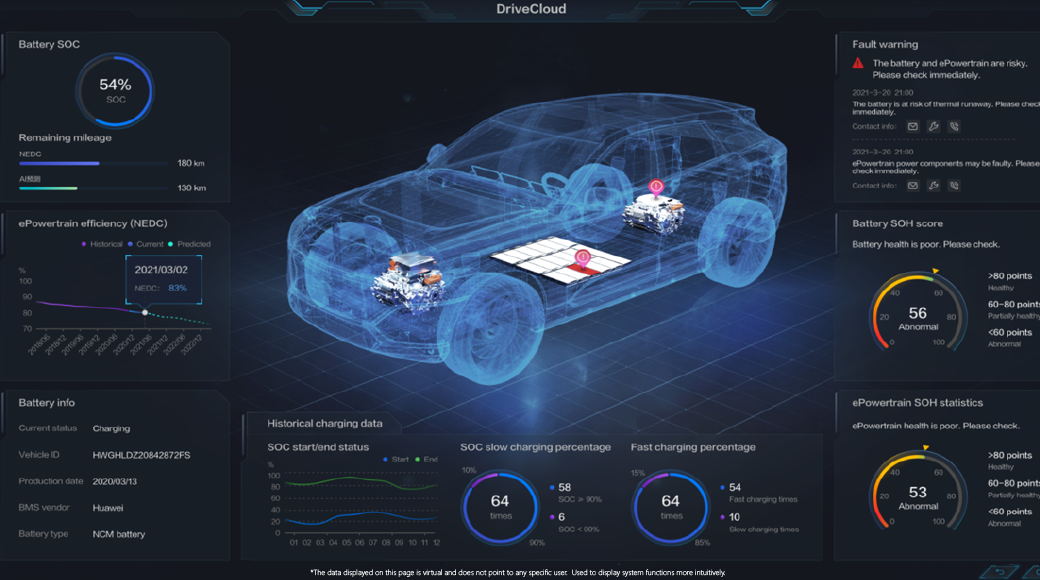
Huawei AI BMS providing a visualized safety management platform for power
components of automakers
Four-Step Process of Huawei AI BMS
✦ Data governance:
AI experts eliminate false warnings, complete data and remove duplicates, improving the accuracy and
efficiency of model operation.
✦ Feature engineering construction:
Combining years of battery mechanism experience, construct high-sensitivity features strongly related to
battery failures to raise the dimension of data features. The feature subset is screened to improve the
algorithm efficiency.
✦ Algorithm design:
Huawei comprehensively adopts a variety of industry classic algorithm frameworks, such as neural
networks, decision trees, and random forests. By customizing the algorithm hyperparameters, Huawei has
developed a highly sensitive algorithm model that corresponds to the battery thermal runaway fault.
✦ AI model training and optimization: AI experts "label" the data in the training set based
on rich experience to complete model learning. After the data model training and optimization are mature,
the test set data is used for model testing. Continuous iterative optimization and tuning of the AI model
helps quickly achieve performance goals and accurately predict potential battery safety risks.
Huawei AI BMS Issues Warnings 24 Hours in Advance
Continuously Building AI Cloud Platform Capabilities, Ensuring EV Safety
Several automakers have commercial partnerships with Huawei. Huawei AI BMS has analyzed data from more than
100,000 EVs, and successfully warned of 10+ battery thermal runaways in advance, preventing accidents. The
large sample size facilitates continuous optimization and iteration of the thermal runaway model. With the
enrichment and optimization of multi-dimensional battery parameters, the full coverage of the highly
sensitive dimensions of data, and the evolution of AI algorithms, Huawei AI BMS will further improve the
fault detection rate, lower the error rate, issue warnings earlier, and improve the safety of the power
battery system. Huawei DriveONE will provide component-level fault warning, as well as full life cycle
health and life management for the three core components (battery, motor, and electronic control) of EVs,
guaranteeing vehicle safety and facilitating safer and greener driving.